Smart Meter in India: The Complete Consumer Guide (2026)
By Electric Bill Editorial Team | 18 min read
Last Updated: October 16, 2026
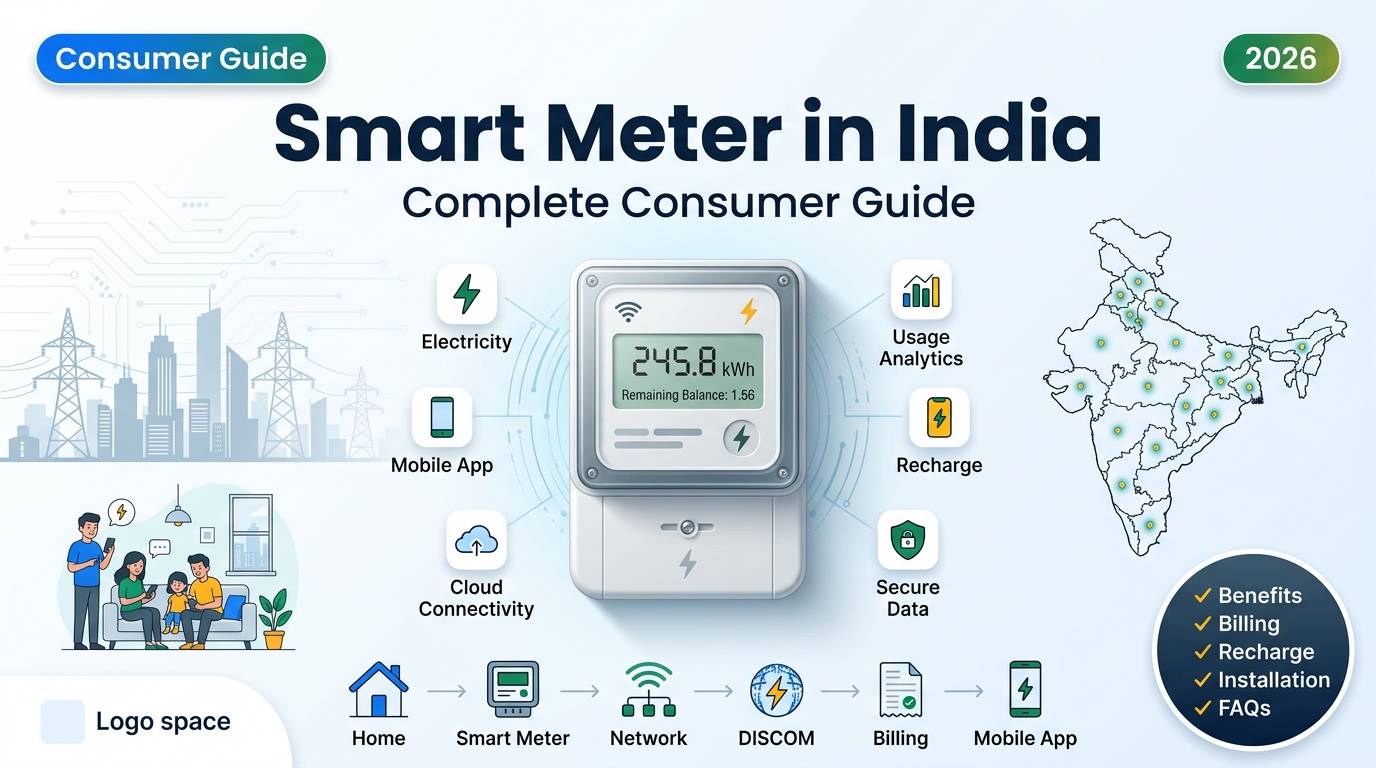
Table of Contents
- What is a Smart Meter?
- How Smart Meter Works
- Types of Smart Meters
- Smart Meter vs Traditional Meter
- Benefits of Smart Meter
- Possible Limitations
- How Smart Meter Billing Works
- How to Check Smart Meter Reading
- How to Recharge Smart Meter
- Emergency Credit
- Common Smart Meter Problems
- Smart Meter Myths vs Facts
- Smart Meter Safety
- Smart Meter Installation Progress Across India
- Frequently Asked Questions
Smart Meter Guide
India is currently witnessing a massive transformation in its energy sector. Under the Union Government's Revamped Distribution Sector Scheme (RDSS), millions of traditional spinning disk and simple digital meters are being replaced with advanced smart meters. This shift is designed to modernize the electricity grid, reduce energy losses, and give consumers real-time control over their power usage. However, this sudden change has also brought a lot of questions and confusion among everyday users.
Whether you are a homeowner trying to figure out why your balance drops daily, a tenant trying to understand prepaid recharge rules, or a student looking into grid modernization, this comprehensive guide is built for you. We explain everything about smart electricity meters in India in simple, jargon-free language. Keep in mind that electricity rules, recharge apps, and tariff slabs vary by state and distribution company (DISCOM), so always verify exact terms with your local electricity board.
Before diving into details, you can always check your current or estimated slab-wise charges using our main Electricity Bill Calculator or browse specific state rules in our utility guide section.
1. What is a Smart Meter?
A Smart Meter is an advanced digital electricity meter that records your energy consumption in short intervals (typically every 15 to 30 minutes) and transmits this data securely to your electricity provider (DISCOM). Unlike the old mechanical meters that relied on physical spinning dials, or simple digital meters that required a meter reader to visit your home every month, a smart meter utilizes bidirectional communication technologies.
The main purpose of a smart meter is to eliminate manual errors and make energy consumption transparent. With a smart meter, you no longer have to wait for a physical bill at the end of the month. Instead, you can track how much electricity you consume on a daily or hourly basis via a web portal or a dedicated mobile application.
In India, the transition to smart meters is driven by the central government's Revamped Distribution Sector Scheme (RDSS). The project aims to replace 250 million conventional meters with prepaid smart meters across the nation. This is intended to help financially stressed electricity boards cut down on commercial losses, prevent electricity theft, and improve the reliability of the power supply.
Under the RDSS guidelines, the installation of smart meters is sponsored and subsidized by the central government. Consumers do not have to pay upfront installation charges for the meter itself, though security deposits and connection charges continue to apply as per local regulatory norms.
2. How a Smart Meter Works
A smart meter acts as a small, specialized computer installed on your premises. Let us break down the flow of how information and billing travel back and forth in a loop:
Step 1: Consumption
Appliances consume power. The smart meter records usage in real-time.
Step 2: Transmission
Data travels via RF or GPRS (SIM Card) to the DISCOM system.
Step 3: Processing
Billing server applies tariff slabs and updates your balance.
Here is how the complete communication cycle works in detail:
- Meter to Communication Network: The smart meter has a built-in cellular SIM card (using GPRS/4G/5G) or connects via a Radio Frequency (RF) mesh network. It automatically uploads your cumulative kWh readings at scheduled intervals to a local receiver called a Data Concentrator Unit (DCU).
- Network to DISCOM Billing Server: The DCU sends your readings to the Central Meter Data Management System (MDMS) of your DISCOM. The MDMS processes these readings and feeds them into the billing server, which calculates your usage costs dynamically based on the state’s current tariff slabs.
- Server to Mobile App / Consumer: The processed billing information is pushed to the consumer's mobile app (such as Bihar's Suvidha app, Adani Electricity app, Tata Power app, etc.). If you are on a prepaid connection, your balance is deducted daily. If your balance runs low, the system automatically sends SMS warnings asking you to recharge.
3. Types of Smart Meters
Depending on your sanctioned load, consumer category, and local regulations, you will be allocated one of the following types of smart meters:
- Prepaid Smart Meters: These work just like a prepaid mobile connection. You load money into your electricity account in advance. As you use power, money is deducted daily. If your balance drops to zero, the power supply gets disconnected automatically after a grace period. This is the primary model being rolled out for domestic consumers across India.
- Postpaid Smart Meters: These operate under the traditional monthly billing method. The meter measures usage and sends the reading automatically at the end of the month. The DISCOM issues a bill which you must pay by the due date. The main difference is that no meter reader needs to visit your house to generate the bill.
- Single Phase Smart Meters: Designed for small domestic setups, single-phase meters are used for standard household loads, usually up to 5 kW or 7 kW. They handle basic appliances like lights, fans, TVs, computers, single small ACs, and water pumps.
- Three Phase Smart Meters: Installed in larger homes, commercial shops, and industrial units with sanctioned loads above 5 kW to 7 kW. They are essential for running heavy machinery, central AC plants, large motors, or multiple air conditioners simultaneously.
- AMI (Advanced Metering Infrastructure) Meters: This is the technical umbrella term for meters integrated into a smart network. They support remote diagnostics, alarm reporting during power failures, remote load limiting, and tamper detection alerts.
4. Smart Meter vs. Traditional Meter
To understand the difference this upgrade brings, let us compare the features of a modern smart meter with those of a traditional electromechanical or digital meter side-by-side:
| Feature | Traditional Meter | Smart Meter (Prepaid/Postpaid) |
|---|---|---|
| Accuracy | Prone to mechanical wear, slow readings over time. | Highly accurate electronic solid-state calibration. |
| Billing | Monthly billing based on manual readings. | Real-time updates, daily calculations. |
| Manual Reading | Mandatory; reader must physically access the meter. | Not required; readings transmitted remotely. |
| Remote Reading | Not supported. | Fully supported via cellular or radio link. |
| Remote Disconnect | Requires a physical visit by a lineman. | Instant disconnection/reconnection from server. |
| Tamper Detection | Only visible during physical inspections. | Triggers immediate automatic alarms to control room. |
| Energy Monitoring | Only monthly total units (kWh) visible. | Hourly/daily load profiling visible in app. |
| Prepaid Support | No (requires mechanical card attachments). | Native support with remote digital wallet. |
| Mobile App Integration | No app integration. | Full status, recharge history, and load tracking. |
Advantages
- No Billing Surprises: You can see exactly how much electricity you are consuming each day, preventing unexpected bill shock at the end of the month.
- Better Planning: By analyzing hourly charts, you can move power-heavy chores (like washing clothes or running geysers) to non-peak hours if your board offers Time-of-Day (ToD) tariff discounts.
- Auto-reconnection: When prepaid balance runs out and cuts supply, recharging the account restores power automatically within 5 to 15 minutes, with no need to call a technician.
Disadvantages
- Network Dependencies: In areas with poor mobile signal coverage, smart meters struggle to transmit readings, which can cause delayed balance updates or billing glitches.
- Abrupt Cut-offs: If you miss recharging a prepaid meter, you face automatic power cuts, although rules prevent disconnection at night, on weekends, or national holidays.
5. Benefits of Smart Meter
The adoption of smart meters benefits different stakeholders in the power infrastructure. Let us examine how everyone stands to gain:
- Consumer Benefits: Better budgeting of energy expenses, removal of human billing errors, convenience of remote digital recharges, and zero disruption from physical meter readers visiting your home. Consumers also receive notifications when consumption crosses threshold limits.
- DISCOM Benefits: Near-zero commercial losses, automated collections, elimination of manual reader labor costs, immediate alerts when someone tries to bypass or tamper with a meter, and detailed demand profiling to buy power cost-effectively.
- Government Benefits: Successful execution of energy conservation targets, reduced financial strain on public sector discoms, and precise grid management. This supports the transition towards smart city frameworks.
- Environmental Benefits: Improved usage tracking leads to reduced carbon footprints. Furthermore, discoms can easily integrate rooftop solar grids and net-metering schemes, making clean energy adoption much smoother.
6. Possible Limitations & Challenges
While smart meters offer multiple advantages, it is important to address their current limitations and challenges objectively. This helps set realistic expectations for users experiencing the transition:
- Network Dropouts: Smart meters rely on cellular cellular signals (GPRS/4G/5G). In dense concrete basements or remote rural locations, poor signal quality can delay consumption reporting, resulting in back-billing updates that catch consumers off guard.
- Recharge Sync Lag: Sometimes, when you recharge your prepaid meter account online, it can take anywhere from 10 minutes to an hour for the server to send the "reconnect" command to your physical meter. This is usually due to network congestion or server overload.
- Transition Confusion: In many states, older pending bills are converted into "installments" and deducted daily from the new prepaid meter. Many consumers do not understand this and feel their new smart meter is "stealing money," leading to customer complaints.
7. How Smart Meter Billing Works
Smart meter billing does not introduce any hidden charges or higher rates. It utilizes the exact same tariff rules and slabs approved by your State Electricity Regulatory Commission (SERC) for traditional meters. The only difference is that instead of a monthly calculation, the billing server processes your charges on a daily basis.
Your electricity cost is made up of several components:
- Energy Charges (Slab Rates): You pay per unit (kWh) consumed. The rate increases as you cross specific consumption slabs (e.g., 0-100 units, 101-200 units, etc.).
- Fixed Charges: A monthly charge determined by your sanctioned load (in kW). In smart prepaid meters, this fixed cost is divided by 30 and deducted in small amounts daily.
- Electricity Duty & FPPCA: Electricity Duty is a state government tax. Fuel and Power Purchase Cost Adjustment (FPPCA) is an extra charge per unit that fluctuates depending on coal and fuel costs incurred by the utility.
Step-by-Step Calculation Example
Let us assume a household in a typical Indian city with a sanctioned load of 2 kW uses 300 units (kWh) in a month. Here is how the bill is calculated under a simplified domestic tariff structure:
| Billing Component | Tariff Rate | Calculation | Total Cost |
|---|---|---|---|
| Slab 1 (0 - 100 units) | Rs. 4.00 per unit | 100 units x Rs. 4.00 | Rs. 400.00 |
| Slab 2 (101 - 200 units) | Rs. 6.00 per unit | 100 units x Rs. 6.00 | Rs. 600.00 |
| Slab 3 (201 - 300 units) | Rs. 8.00 per unit | 100 units x Rs. 8.00 | Rs. 800.00 |
| Fixed Charges (2 kW load) | Rs. 100 per kW per month | 2 kW x Rs. 100 | Rs. 200.00 |
| FPPCA surcharge | Rs. 0.25 per unit | 300 units x Rs. 0.25 | Rs. 75.00 |
| Electricity Duty (Tax) | 9% on energy bill | 9% of Rs. 1,800 | Rs. 162.00 |
| Grand Total Monthly Cost | Rs. 2,237.00 | ||
If you are on a prepaid smart meter, the DISCOM server won't wait until day 30 to deduct Rs. 2,237. Instead, it will calculate your daily usage. For instance on a day you consume 10 units, it will deduct the slab cost for those units, plus a daily fixed charge allocation of Rs. 6.66 (Rs. 200 / 30 days) and associated duties, keeping your balance updated on a rolling basis.
Because rates vary across different states and DISCOMs, we highly recommend trying out our State-wise Electricity Bill Calculators to calculate your bills according to the specific rules of your region.
8. How to Check Smart Meter Reading
Every smart meter has a digital liquid crystal display (LCD) on the front panel. There is usually a push-button located next to the display. If you press this button repeatedly, the screen cycles through various parameters. Alternatively, the meter automatically scrolls through these parameters every few seconds. Here are the key codes and symbols you should look for:
- Cumulative Active Energy (kWh): This is the most important value. It shows the total units of electricity consumed since the meter was installed. This is the reading used to calculate your bill. It is displayed alongside the letters "KWH".
- Current Balance (for Prepaid): Many prepaid meters will display your remaining balance directly on the screen in Rupees (e.g., "BAL 450.50"). This helps you quickly check if a recharge is needed without checking the app.
- Instantaneous Load (kW): Shows the real-time load currently running in your house. For instance, if you turn on an AC and a water heater, this value will instantly shoot up to something like "2.8 kW". It helps identify power-hungry appliances.
- Voltage (V) & Current (A): Shows the voltage incoming from the grid (normally around 220V to 240V for single phase) and the current drawn in Amperes (A) by your home.
9. How to Recharge Your Smart Meter
If you have a prepaid smart meter, keeping a positive balance is essential to prevent automatic power cuts. The recharge process is fully digital and varies depending on your electricity board, but generally follows these steps:
- 1. Locate Your Consumer ID: You will need your Consumer Number (also called Consumer Account Number, CA Number, or K-No) which is printed on your old bills or displayed on the smart meter app.
- 2. Use the Official Portal or App: Open your state DISCOM's official mobile application or visit their web portal (e.g., Bihar Suvidha App, WBSEDCL App, UPPCL website). It is highly recommended to use official channels to avoid payment delays.
- 3. Complete Payment: Enter your consumer details, review the current balance, select your recharge amount, and complete the transaction using secure options like UPI, Debit/Credit Cards, or Net Banking.
Avoid using unverified third-party utility applications or agents that promise massive discounts. If there is a delay in updating the recharge on the DISCOM server, your power supply could cut off, and getting a refund or manual credit updates can take days.
10. Understanding Emergency Credit
To ensure that families are not left in the dark unexpectedly, prepaid smart meters feature an Emergency Credit mechanism. This acts as a buffer safety net when your balance drops to zero or goes negative.
- Non-Disconnection Hours: DISCOM rules generally forbid automatic power disconnections during night hours (e.g., between 6:00 PM and 10:00 AM) and on public holidays or weekends. If your balance hits zero during these hours, the meter goes into a negative balance mode, keeping your lights on.
- Emergency Credit Activation: Some meters allow you to activate a temporary credit buffer (ranging from Rs. 100 to Rs. 500 depending on the state) by pressing the push button on the meter for 5 seconds. This provides extra runtime to recharge your account.
- Adjustment on Next Recharge: Any emergency credit or negative balance consumed during the buffer period will be immediately deducted from your next recharge amount. For example, if you consumed Rs. 150 of emergency credit and recharge with Rs. 500, your new wallet balance will be Rs. 350.
11. Common Smart Meter Problems & Consumer Actions
Like any electronic system, smart meters can experience technical glitches. If you run into issues, here is what is likely happening and the action you should take:
| Problem | Probable Cause | Recommended Action |
|---|---|---|
| Prepaid balance drops rapidly | Adjustment of old pending arrears, or high instant load (e.g. earth leakage). | Check your ledger in the official app. If there are no arrears, hire an electrician to check for internal wiring leakages. |
| Recharged online, but power remains off | Delay in server-to-meter communication over GPRS network. | Wait 15 minutes. If power is still off, press the push button on the meter for 5 seconds to force-refresh, or call the helpline. |
| Smart Meter display is blank | Internal component failure or power supply cutout. | Report immediately to your DISCOM. It is their responsibility to repair or replace the meter free of charge. |
| Meter shows 'Tamper' error light | Strong magnetic fields nearby, loose terminal cover, or neutral mismatch. | Do not try to fix it yourself. Lodge a complaint with the electricity board immediately to avoid penal charges. |
| App balance is different from Meter screen | Sync delay. The mobile app updates once or twice a day, while the meter screen is real-time. | Trust the physical meter screen reading over the app, as it represents the local physical relay state. |
12. Smart Meter Myths vs. Facts
Due to a lack of clear information, several misconceptions have spread among consumers regarding smart meters. Let us address these myths with verified facts:
- Myth 1: Smart meters run faster and increase bills.
Fact: Smart meters do not run faster. Older mechanical meters slowed down over time due to friction, leading to under-billing. Smart meters measure electricity with digital accuracy, recording even low-power idle appliances (like chargers left plugged in), which makes bills seem slightly higher initially. - Myth 2: Smart meters emit harmful radiation.
Fact: The wireless signal emitted by a smart meter is similar to a weak mobile phone text message and lasts only a few milliseconds. It is completely safe and operates far below international limits set for household devices like Wi-Fi routers. - Myth 3: Smart meters consume their own electricity and charge you for it.
Fact: While smart meters require a tiny amount of electricity to power their display and cell modem, this internal power is drawn from the grid side (before the metering sensor) and is not billed to the consumer. - Myth 4: The DISCOM can spy on what you are doing in your home.
Fact: Smart meters only record the cumulative volume of electricity consumed. They cannot see what specific appliance is running, let alone monitor your personal daily activities. - Myth 5: Prepaid meters cut power instantly at midnight if you run out of money.
Fact: Disconnections are programmed to occur only during designated daytime working hours (usually 10:00 AM to 1:00 PM or similar) on business days. Power will not cut out at night, on Sundays, or during state holidays. - Myth 6: Recharging a smart meter online is insecure.
Fact: The payment portals use the same bank-grade encryption protocols as other online financial services. Recharging via official DISCOM websites is highly secure. - Myth 7: If a smart meter fails, you have to pay a massive penalty.
Fact: Unless there is evidence of physical tampering or deliberate damage, any technical failure of a smart meter is covered by the manufacturer and the DISCOM. They will replace it for free. - Myth 8: Smart meters can catch fire easily.
Fact: Smart meters are built with flame-retardant materials and pass rigorous Indian Standard (IS 13779) safety tests. Fire hazards only arise if the service wiring connected to the meter terminals is loose or done poorly by local installers. - Myth 9: You cannot get a solar connection if you have a smart meter.
Fact: Smart meters make solar integration easier. They support bidirectional net-metering, keeping track of both import from grid and export from your solar panels. - Myth 10: DISCOMs use smart meters to charge random, unofficial taxes.
Fact: All charges applied in the billing ledger must match the tariff order approved by the state's independent regulator (SERC). DISCOMs cannot charge anything outside this tariff order.
13. Smart Meter Safety & Security
Safety and security are primary concerns for consumers in our increasingly connected digital landscape. Smart meters are designed to meet strict benchmarks across multiple levels:
- Electrical Safety: Smart meters are certified under Bureau of Indian Standards (BIS) parameters. They are equipped with internal surge protectors to handle normal voltage fluctuations and are housed in fire-resistant poly-carbonate casings.
- Data Privacy: The data sent to the DISCOM is encrypted during transit and stored in secure data centers. Access to individual consumer profiles is heavily restricted and governed by Indian data privacy laws.
- Cyber Security: Smart grids use a dedicated private Virtual Private Network (VPN) and APN configurations on cellular networks. They are isolated from the public internet, preventing unauthorized individuals from hacking into meters or shutting down regional power grids.
14. Smart Meter Installation Progress Across India (2026)
The rollout of smart meters is being executed in phases across India. While some states have achieved high deployment figures in urban areas, others are currently executing pilot programs or initial planning. Here is an overview of the status across major states as of 2026:
| State / UT | Key Electricity Board / DISCOM | Rollout Status | Remarks / Progress | Official Website |
|---|---|---|---|---|
| Bihar | NBPDCL, SBPDCL | Widely Deployed | A frontrunner in smart prepaid meter deployment. Millions of installations completed in both urban and rural areas. | BSPHCL |
| Uttar Pradesh | UPPCL (PUVVNL, MVVNL, PVVNL, DVVNL) | Large Scale Rollout | Large-scale rollout is ongoing in cities like Lucknow, Noida, and Varanasi, transitioning gradually to prepaid metering. | UPPCL |
| Maharashtra | MSEDCL (Mahadiscom), Adani Electricity, Tata Power | Large Scale Rollout | Adani and Tata Power have deployed widely in Mumbai. MSEDCL is actively rolling out smart meters in major urban hubs across the state. | MSEDCL |
| Delhi | TPDDL (Tata Power), BSES (BYPL, BRPL) | Completed in Selected Areas | Very high penetration of smart meters in consumer households. Focus is on demand management and load profiling. | TPDDL |
| Kerala | KSEB | Ongoing / Selected Rollout | Rollout is ongoing, focusing on commercial & high-value domestic connections first. Residential expansion is ongoing. | KSEB |
| Tamil Nadu | TANGEDCO (TNEB) | Pilot / Selected Rollout | Smart meters are currently active in selected areas of Chennai. Wider rollout planning is under process. | TANGEDCO |
| Karnataka | BESCOM, MESCOM, HESCOM, GESCOM, CESC Mysore | Ongoing | Deployment under progress. BESCOM area leads the rollout with commercial units being prioritized first. | BESCOM |
| Gujarat | DGVCL, UGVCL, MGVCL, PGVCL, Torrent Power | Large Scale Rollout | Steady execution under RDSS guidelines. Urban centers and industrial areas are receiving priority installations. | GSEB |
| West Bengal | WBSEDCL, CESC | Ongoing / Pilot | CESC area has deployed in parts of Kolkata. WBSEDCL is starting phases in select districts. | WBSEDCL |
| Telangana | TSSPDCL, TSNPDCL | Ongoing | Active rollout in commercial spaces and government offices across Hyderabad, extending to high-load homes. | TSSPDCL |
| Andhra Pradesh | APSPDCL, APEPDCL, APCPDCL | Ongoing | Targeted rollout for government buildings and industrial zones, transitioning slowly to residential divisions. | APSPDCL |
| Punjab | PSPCL | Ongoing / Pilot | Initial deployment active under pilot schemes in industrial regions like Ludhiana and Patiala. | PSPCL |
| Rajasthan | JVVNL (Jaipur), AVVNL (Ajmer), JdVVNL (Jodhpur) | Ongoing | Phase-wise deployment starting with state capitals and industrial areas before rural expansion. | Rajasthan Energy |
| Jharkhand | JBVNL | Ongoing / Selected Rollout | Installations are progressing in urban centers like Ranchi and Jamshedpur. | JBVNL |
| Assam | Assam Power Distribution (APDCL) | Large Scale Rollout | Actively deploying prepaid smart meters across Guwahati and surrounding towns under the RDSS project. | APDCL |
| Himachal Pradesh | HPSEBL | Ongoing / Pilot | Pilot projects underway in tourist and commercial hubs like Shimla and Dharamshala. | HPSEBL |
| Goa | Goa Electricity Department | Pilot / Planned | Initial planning complete. Deployment expected in tourist hubs and cities like Panaji shortly. | Goa Electricity |
| Puducherry | Puducherry Electricity Department | Pilot / Planned | Plans drafted for smart meter transition in municipal areas. Rollout under formulation. | Puducherry Electricity |
Note: The rollout status of smart meters shifts quickly as projects progress. You should check the official web portal of your local electricity board or contact your local division office for current updates regarding your neighborhood.
15. Frequently Asked Questions (FAQs)
- What is a smart prepaid meter?
A smart prepaid meter is an electronic device that tracks your power usage and deducts costs daily from a preloaded digital wallet balance. You pay in advance for electricity, similar to recharging a prepaid mobile network connection. - Will a smart meter increase my monthly electricity bill?
No, smart meters do not increase electricity bills. They use the same tariff rates as traditional meters. However, since they are highly accurate and digital, they record minor power leakages and standby consumption that older mechanical meters often missed, making your bills look slightly higher initially. - How do I check my remaining balance?
You can check your balance in two ways: first, by looking at your DISCOM's official mobile application (which updates once or twice a day), and second, by pressing the push button on your physical meter until the screen displays your balance in Rupees (e.g. BAL 250.00). - What happens if my prepaid balance hits zero?
When your balance hits zero, the electricity supply will be cut off automatically. However, disconnections do not occur at night, during weekends, or on national holidays. Instead, the meter allows you to run on emergency credit until the next business day. - How can I recharge my smart prepaid meter?
You can recharge online by visiting your state electricity board's official website or by using their official mobile app. Simply enter your consumer ID or account number, choose your payment mode (UPI, Netbanking, or cards), and make the payment. - How long does it take for power to return after I recharge?
In most cases, the system sends an automatic connection signal over cellular networks, restoring your power within 5 to 15 minutes. If it takes longer, try holding down the physical push button on your meter for 5 seconds to force a refresh. - Do I have to pay installation charges for the new smart meter?
No, under the government's RDSS scheme, traditional meters are replaced with smart meters at no cost to the consumer. Be careful of scammers claiming to be board workers demanding cash for installation. - Can a smart meter record energy during power outages?
No, when there is a power outage in your area, no electricity passes through the meter, and nothing is recorded. The internal electronic memory stores your cumulative consumption index safely until power returns. - What is emergency credit, and how do I use it?
Emergency credit is a temporary monetary buffer (like Rs. 100 or Rs. 200) provided by the utility. You can activate it via your DISCOM mobile app or by holding down the meter's push button when the balance runs out. The buffer amount is deducted from your next recharge. - Are the radiation levels from smart meters dangerous?
No, not at all. Smart meters use low-power radio signals or cellular networks to send readings, similar to sending a text message once or twice a day. The exposure is a tiny fraction of what you receive from your smartphone or Wi-Fi router. - Can a smart prepaid meter cut off power during the night?
No, standard national rules prevent automatic power cuts during non-business hours (typically between 6:00 PM and 10:00 AM) or on Sundays and gazetted holidays, even if your balance falls below zero. - What should I do if my meter screen goes blank?
A blank screen indicates a technical fault. You should report this immediately to your DISCOM's customer care division. They will inspect the unit and replace it free of cost if it is broken. - Can I track my hourly electricity usage?
Yes, the official mobile application of your DISCOM typically lists detailed bar charts showing your consumption hourly, daily, or weekly, helping you find which times of day consume the most power. - Why did my prepaid balance go negative right after installation?
When a smart meter is installed, the DISCOM transfers any outstanding bills or unpaid arrears from your old meter into the new prepaid account. To avoid placing a sudden burden on you, these arrears are deducted in small, interest-free daily installments. - Can I bypass or tamper with a smart meter to lower my bill?
No, attempting to open, bypass, or place magnets near a smart meter is highly dangerous and illegal. The meter's internal sensors instantly transmit a tamper alert to the DISCOM head office, which can lead to power cuts and severe legal penalties. - How do fixed charges work in prepaid smart meters?
Instead of charging you the entire monthly fixed charge (based on your sanctioned load) in a single bill, the system divides the charge by 30 and deducts a small fraction from your balance every day. - What is the difference between single-phase and three-phase smart meters?
Single-phase meters are used for standard residential homes with small loads (typically up to 5 kW). Three-phase meters are installed in larger residences, commercial establishments, or industries that use heavy equipment like large motors or multiple central AC systems. - Will my smart meter work if there is no mobile network in my area?
Yes. If cellular network signal is absent, DISCOMs set up a Radio Frequency (RF) mesh network where meters talk to each other to send readings to a central receiver. If both fail, the board will arrange a manual optical read until coverage returns. - Are smart meters safe from cyber attacks or hacking?
Yes. Smart meters communicate over secure, private APN channels managed by cellular companies. The system is isolated from the public internet, making it highly secure against external hacking attempts. - How does FPPCA charge work on a smart meter?
FPPCA (Fuel and Power Purchase Cost Adjustment) is calculated per unit of electricity consumed. If your state regulator approves an FPPCA adjustment, it is added to your daily unit consumption charge. - Can I switch from prepaid to postpaid mode in a smart meter?
This depends entirely on the policies of your state's electricity board. Under the current RDSS scheme guidelines, most domestic installations are mandatory prepaid, but some states allow high-load consumers or specific categories to choose postpaid mode. - What is a Time-of-Day (ToD) tariff, and does my smart meter support it?
A ToD tariff is a billing method where electricity rates are cheaper during off-peak hours (like daytime when solar power is high) and more expensive during peak evening hours. Smart meters fully support ToD, allowing you to save money by running heavy loads when rates are low. - Does my smart meter support solar net-metering?
Yes, modern smart meters are designed to act as bidirectional net-meters. They measure both the energy you import from the grid and the excess solar energy you export back to it, applying net bill calculations accordingly. - Can a tenant pay the smart meter recharge, or is it the owner's job?
Anyone can recharge the smart meter online as long as they have the Consumer ID. The transaction does not require the owner's credentials. It behaves like recharging a mobile phone, making it convenient for tenants to manage their own consumption. - Who do I contact if I disagree with the daily deduction amount?
You should contact your local DISCOM's customer helpline or visit your local electricity subdivision office. Request a detailed billing ledger (or daily consumption sheet) which shows how units were calculated against the approved tariff slabs.
Conclusion
Smart meters are a vital step in upgrading India's electrical infrastructure, offering clear benefits like real-time tracking, accurate billing, and convenient online recharges. While adapting to prepaid billing and troubleshooting early technical or network glitches can take some adjustment, these meters ultimately provide transparency and help prevent unexpected billing surprises.
Always stay informed by tracking your consumption patterns daily, recharging through official channels, and checking updates directly from your local state electricity board or DISCOM.