Electricity Bill Name Change: Complete Guide to Meter Name Transfer
By Electric Bill Editorial Team | 15 min read
Last Updated : October 15, 2026
Electricity Bill Name Change
Changing the name on your electricity bill is more than just a clerical update—it is a critical legal procedure that marks the official transfer of financial and legal accountability for power consumption in a property. Whether you have just purchased your dream home, inherited a property from a deceased family member, or are adjusting the details of a commercial space, having the correct name on your utility documents is essential for address proof, legal compliance, and future property transactions.
In India, where utility bills often serve as primary KYC (Know Your Customer) documents, any discrepancy in the name can lead to significant hurdles. You might face issues when applying for a passport, opening a bank account, or even filing for local municipal permits if your electric meter still reflects the name of a previous landlord or owner. Transitioning the ownership of an electric meter, often referred to as an electric bill name transfer, ensures that the legal liability for usage, dues, and penalties rests with the current occupant or owner.
This comprehensive guide will walk you through everything you need to know about how to change name in electricity bill. From the mandatory document checklist to the step-by-step online and offline procedures, and state-specific examples like Uttar Pradesh (UPPCL), Bihar (NBPDCL/SBPDCL), and Jharkhand (JBVNL), we have covered it all to make your experience hassle-free.
What is Electricity Bill Name Change?
At its core, an electricity bill name change—officially termed as a 'Change of Name' or 'Ownership Transfer' by most Distribution Companies (DISCOMs)—is the legal process of updating the consumer records associated with a specific Service Connection (SC) or Contract Account (CA) number. When you initiate this process, you are essentially informing the electricity board that the person previously responsible for paying the bills (the transferor) is no longer the legal owner or occupant, and that you (the transferee) are now taking over all rights and liabilities associated with that power connection.
This process is not just about the text printed on the monthly invoice. It involves updating the contract between the consumer and the utility provider. This means:
- The security deposit (SD) held by the board must be transferred or adjusted in the name of the new owner.
- You become legally liable for any unpaid dues or penalties incurred after the transfer date.
- You gain the legal authority to request meter upgrades, load extensions, or solar net-metering installations.
Without a formal name change, you are essentially using a utility service under someone else's name, which can be deemed a violation of terms by many electricity boards, potentially leading to disconnection if the board discovers the property has changed hands without notification.
When You Need to Change Name in Electricity Bill
Understanding when to initiate an electric bill transfer name process is key to avoiding last-minute legal panics. Here are the most common scenarios where a name change is mandatory:
1. Purchase of a New/Old Property
When you buy a resale flat or a house, the electricity meter remains in the name of the original owner. As part of your post-purchase documentation (similar to House Tax or Mutation), you must transfer the electric meter to your name using the Sale Deed as proof.
2. Death of the Registered Owner
If the electricity connection is in the name of a person who has passed away, the legal heirs (spouse, children, or parents) must transfer the connection to their name. This requires a Death Certificate and a Legal Heir Certificate or NOC from other heirs.
3. Inheritance or Gift Deed
Even if no money is exchanged, if a property is transferred via a Gift Deed or a Will, the utility records must follow the title of the land. The new 'owner' must update the electricity board records within 30-60 days.
4. Change in Company or Entity Name
For commercial connections, if the business name changes (e.g., from 'ABC Traders' to 'XYZ Solutions') while the location remains the same, a formal name change application is required to reflect the new GST and tax identification details.
It is important to note that a rental agreement usually isn't a ground for a permanent name change unless it is a very long-term lease (over 10-15 years) and the landlord explicitly agrees to the transfer. For regular tenants, the bill usually stays in the owner's name.
Required Documents for Electricity Bill Name Change
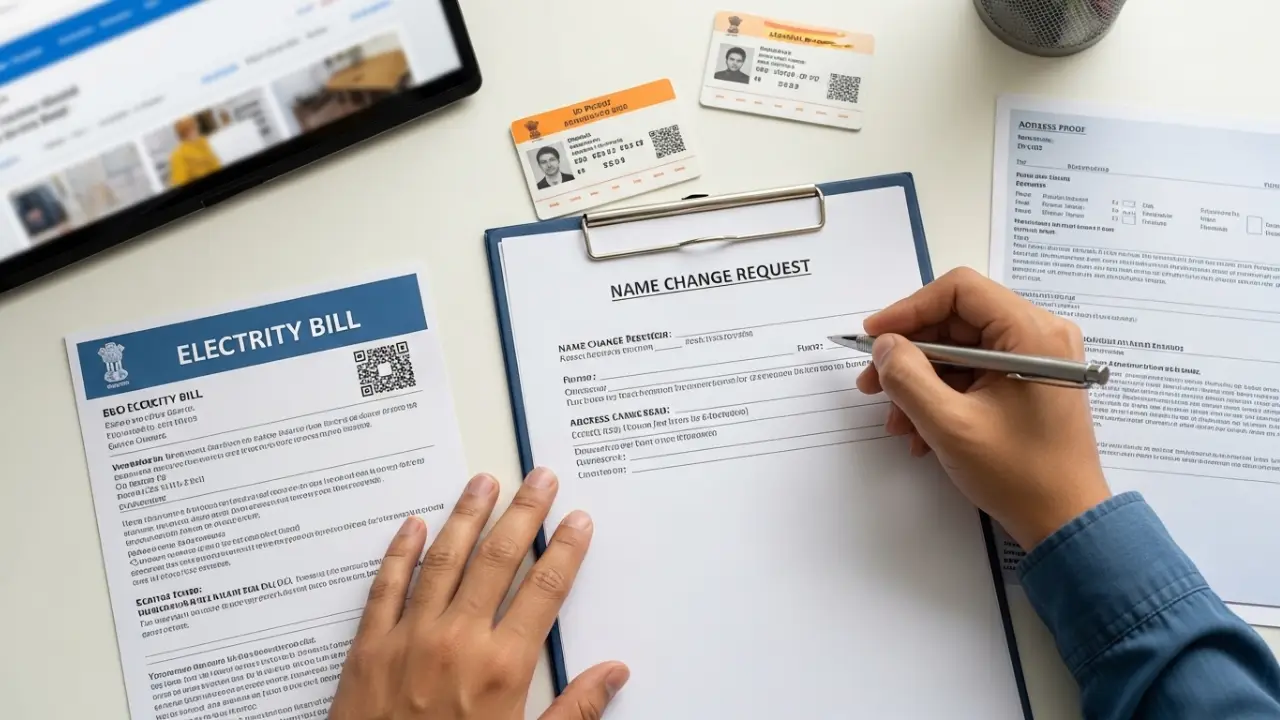
The complexity of the electricity bill name change process often boils down to document preparation. If you have the following papers ready, the process is usually smooth. While specific states might ask for additional forms (like the U-Form or A-Form), the core requirements remain consistent across India:
- ID Proof of the Applicant (Transferee): Aadhaar Card (most preferred), PAN Card, Voter ID, or Passport.
- Proof of Property Ownership: Certified copy of the Sale Deed, Gift Deed, Partition Deed, or Allotment Letter from the housing board/authority.
- Recent Property Tax Receipt: A copy of the latest PAID house tax or municipal tax receipt in your name (Mutation copy is very helpful).
- Copy of the Latest Electricity Bill: A physical copy of the last bill sent to the property (ensure there are no outstanding dues).
- No Objection Certificate (NOC): If the transferor is alive, an NOC signed by them stating they have no objection to the transfer. If they are deceased, an NOC from all other legal heirs is required.
- Passport Size Photographs: Usually 2-3 recent photos for the application form and consumer database.
- Indemnity Bond / Undertaking: A notarized affidavit on stamp paper (usually ₹10 to ₹100 depending on the state) declaring that the transferee will be responsible for any future disputes over the connection.
Before applying, always ensure that all previous dues are cleared. Most electricity boards will automatically reject a name change application if the 'Current Balance' shows anything other than zero. If you are buying a used property, insist that the seller clears the final bill and provides a 'No Dues Certificate' before you sign the sale deed.
How to Change Name in Electricity Bill Online
In 2025, most major DISCOMs in India have digitized their consumer services. The online method for name transfer is often faster and allows you to track the status without multiple visits to the sub-division office. Here is the general step-by-step process used by most boards like UPPCL, TANGEDCO, and BESCOM:
- Visit the Official Portal: Go to the 'Customer Care' or 'Consumer Login' section of your state's electricity board website.
- Register/Login: Create an account using your Consumer Number and the mobile number registered with the connection.
- Select 'Change of Name' Service: Look for the "Consumer Services" menu and select "Request for Transfer of Ownership" or "Name Change."
- Fill the Online Form: Enter the transferee's details (Name, Father's Name, Aadhaar Number, etc.).
- Upload Scanned Documents: Upload clear PDFs or JPEGs of your Sale Deed, ID Proof, and NOC. Make sure the file sizes are within the prescribed limits (usually under 2MB).
- Pay the Application Fee: Pay the nominal processing fee (ranging from ₹100 to ₹500) via Net Banking or UPI. Some boards also require you to pay a difference in Security Deposit if the previous owner's deposit was lower.
- Download Acknolwedgement: Once submitted, note down the Service Request Number (SRN) for tracking.
After online submission, a JE (Junior Engineer) or an inspector might visit your property for a physical verification of the meter and the premises. Once they submit their report, the change is usually reflected in the next billing cycle.
How to Change Name in Electricity Bill Offline
If your state board does not have a reliable online portal, or if you prefer a face-to-face interaction, the offline method is the traditional reliable way. Here is how to navigate it:
- Visit the Sub-division Office: Identify your local electricity office (usually the one mentioned on your bill) and visit the 'Consumer Clerk' or 'Revenue Officer' desk.
- Obtain the Application Form: Ask for the 'Transfer of Ownership' form (often called Form A or NSC Form). You can often buy this for a few rupees at the office counter or nearby bookstores.
- Submit Documents: Attach self-attested copies of all the documents listed in our checklist above. It is advisable to carry the original documents for cross-verification.
- Get the NOC Notarized: If the previous owner is not present, ensure you have a notarized affidavit stating you are now the legal occupant/owner.
- Pay Fees at the Cash Counter: Once the clerk verifies your documents, they will generate a challan. Pay this fee at the counter and collect the receipt.
- Verification Visit: Similar to the online process, an inspector will visit your site within 7-10 days to verify the meter reading and the existence of the consumer.
An expert tip for offline applications is to always get a stamped 'Received' copy of your acknowledgement letter. Utility offices handle thousands of files, and a physical receipt is your only insurance if the file goes missing.
State-wise Example: Jharkhand, Bihar, and Uttar Pradesh
While the general logic is identical, local rules vary slightly. Let's look at three major north-Indian states:
Jharkhand (JBVNL)
In Jharkhand, you can apply via the JBVNL e-Suvidha portal. You must upload your 'Parcha' (land records) or 'Sale Deed'. JBVNL is strict about previous dues; even a ₹10 pending balance can stop the application. The process typically takes 15-21 working days.
Bihar (NBPDCL/SBPDCL)
Bihar has a robust 'Sudha' portal for consumer services. For electric bill name transfer, Bihar consumers need to provide their 'Malguzari' receipt (Revenue receipt) which acts as the ultimate proof of possession. The application fee is often deducted from the next bill.
Uttar Pradesh (UPPCL)
UPPCL (MVVNL, PVVNL, etc.) has a dedicated 'Jhatpat Connection' portal that also handles name changes. In UP, if the property is in a development authority area (like LDA or NOIDA), an allotment letter is sufficient even without a registry copy. UP consumers can track SRN via the UPPCL Consumer App.
Before you start the name change in these states, it is recommended to use our Electricity Bill Calculator to check if you have any hidden pending charges!
Charges and Processing Time for Name Transfer
Many users are concerned about the hidden costs of an electricity bill name change. While the official application fee is usually very low, the total financial impact depends on the Security Deposit (SD).
- Application Fee: Usually ranges from ₹150 to ₹600 for domestic consumers and can go up to ₹2500 for high-tension (HT) industrial connections.
- Security Deposit Difference: If you are transferring a 20-year-old connection, the previous owner might have paid only ₹200 as SD. If current rules for your load (say 2kW) require ₹1500, you will have to pay the ₹1300 difference.
- Process Time: Once the application is accepted, it takes 15 to 30 days. Usually, the name change is reflected in the bill after the next billing cycle.
Common Problems and Solutions
Even with all papers in hand, consumers often hit roadblocks. Here is how to solve the most frequent issues:
- Previous Owner is Unreachable: If you bought a property from someone you cannot contact for an NOC, submit an Indemnity Bond and a copy of the Registered Sale Deed. Power companies prioritize the registered sale deed over a missing NOC.
- Huge Unpaid Dues: If the seller left massive bills, the DISCOM will not transfer the name. You can either pay and seek a refund from the seller legally or approach the Consumer Grievance Redressal Forum (CGRF) if you believe the dues were wrongly calculated.
- Mismatch in Aadhaar vs Deed Name: If the name on your Aadhaar is different from the Sale Deed (e.g., after marriage), attach a Gazette notification or Marriage Certificate to bridge the gap.
Expert Tips for a Hassle-Free Transfer
As experts in utility management, we recommend the following for an easy transition:
- Start Early: Don't wait. As soon as you get possession of the property, start the name change. An old name on the bill might create issues when you want to sell the property or take a home loan.
- Keep Digital Copies: Scan EVERY receipt and application you submit. If the file is delayed, you can use these to follow up with the SDO (Sub-Divisional Officer).
- Verify the First Bill: After the name change is done, check the first bill. Ensure the name spelling is correct and your previous security deposit has been carried forward. If not, raise a complaint immediately.
Frequently Asked Questions (FAQs)
- How much does it cost to change name in electricity bill?
The cost varies by state. Generally, there is an application fee of ₹150–₹500. Additionally, you may need to pay the difference in the Security Deposit if the current requirement for your load is higher than what was previously paid by the old owner. - Can I change the name online?
Yes, most states like UP, Bihar, Jharkhand, Maharashtra, and Tamil Nadu offer online name change services via their official websites or mobile apps. You need to register with your Consumer Number and upload digital copies of the sale deed and ID proof. - Is NOC mandatory if the previous owner is dead?
If the previous owner is deceased, you don't need their NOC. Instead, you need their Death Certificate and an NOC from all other legal heirs who might have a claim on the property, alongside your ownership proof. - How long does the name transfer process take?
Typically, it takes 15 to 30 days. Once the verification visit by the electrical inspector is complete, the name change is usually updated in the database and reflects on the bill in the next billing cycle. - Can a tenant change the name in the bill?
Generally, no. A tenant cannot transfer the ownership of the meter to their name without the landlord's explicit consent and a long-term lease agreement. Most DISCOMs require ownership proof (Sale Deed) for a permanent name change. - What if there are pending dues on the meter?
Electricity boards will reject any name change application if there are pending dues. You must clear all arrears before the system allows you to submit a transfer request. - Is Aadhaar card mandatory for name change?
Yes, Aadhaar is the most widely accepted and often mandatory ID proof for utility services in India nowadays. It is used for e-KYC and linking your mobile number to the connection. - Does the meter number change during name transfer?
No, the physical meter and the meter number remain the same. Only the consumer record and the name associated with the service connection are updated in the utility's database.
Conclusion
In summary, an electricity bill name change is a non-negotiable step for any new property owner or heir in India. While it involves some paperwork and a small fee, the peace of mind and legal security it provides are invaluable. Whether you choose the digital convenience of online portals or the traditional offline method at the sub-division, following the correct document checklist is the key to success.
By updating your utility records, you not only secure a valid address proof but also ensure that your home's energy management is legally sound. Once your name is on the bill, don't forget to keep your energy costs in check using our specialized tools!
Recommended Electricity Tools
Related Guides
Explore more guides to take full control of your electricity bill