How to Calculate Electricity Bill from Meter Reading: A Step-by-Step Guide
By Electric Bill Editorial Team | 8 min read
Last Updated : October 01, 2026
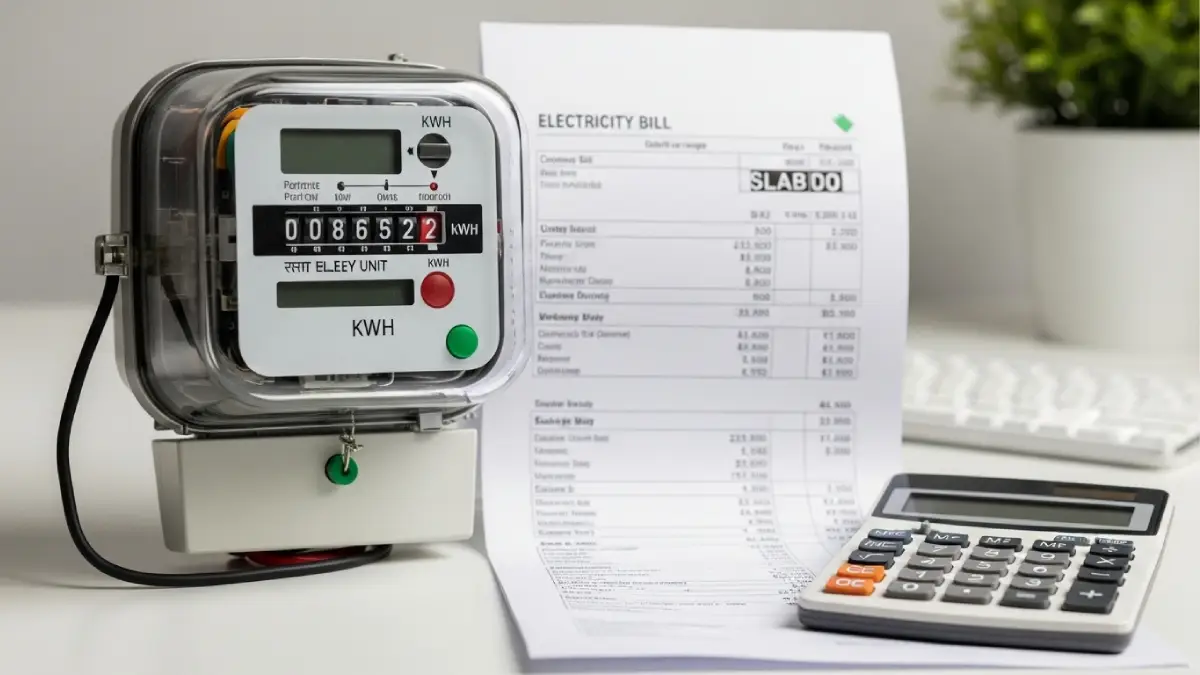
Electric Bill Calculation
Have you ever looked at your electricity bill and wondered how the total amount was calculated? For many of us, the monthly bill is just a number we pay without question. However, understanding how your bill is generated is the first step towards managing your energy consumption and saving money.
In India, electricity billing is slightly more complex than just multiplying units by a rate. It involves slab-based pricing, fixed charges, fuel adjustment charges, and government duties. If you don't know the basics, you might be missing out on opportunities to optimize your usage or spot billing errors.
This comprehensive guide will walk you through the entire process of calculating your electricity bill manually from your meter reading, so you can take control of your household expenses today.
Step 1: How to Read Your Meter
Before you can calculate your bill, you need two numbers: the Current Reading and the Previous Reading.
- Go to your digital electric meter.
- Most meters have a push button. Press it repeatedly until you see a number followed by KWH (Kilowatt Hour).
- Ignore readings like kW (Current Load), kVA, or V (Voltage). Only kWh matters for billing.
- Note this number down. This is your Current Reading.
Your bill's "Units Consumed" is simply:
Current Reading - Previous Reading = Total Units
The Basics: What is a 'Unit'?
Before we dive into calculations, we must understand the fundamental unit of measurement: the Kilowatt-Hour (kWh). In your electricity bill, one 'Unit' is equal to 1 kWh.
But what does that actually mean? Simply put, 1 kWh is the energy consumed by a 1,000-watt appliance running for one hour. For example:
- A 100-watt ceiling fan running for 10 hours = 1 Unit (100W x 10h = 1000Wh = 1kWh).
- A 2000-watt AC running for 30 minutes = 1 Unit (2000W x 0.5h = 1000Wh = 1kWh).
Your electricity meter records these units cumulatively. To find your monthly consumption, you simply subtract last month's reading from the current month's reading.
Understanding Tariff Slabs
Most electricity boards in India follow a 'Telescopic Tariff' structure. This means the rate per unit increases as your consumption goes up. The idea is to clear heavier subsidies for low-consumption households while charging more for high-usage consumers.
For instance, a typical slab structure might look like this:
- 0 - 100 Units: ₹5.00 per unit
- 101 - 300 Units: ₹7.00 per unit
- Above 300 Units: ₹9.00 per unit
Crucially, if you consume 150 units, you don't pay ₹7 for all of them. You pay ₹5 for the first 100, and ₹7 only for the remaining 50. This is a common misconception that leads to confusion.
- Important Note: Some states use 'Non-Telescopic' slabs where crossing a threshold changes the rate for ALL units consumed. Always check your state's tariff order to be sure.
Decoding the Hidden Charges
Your bill isn't just about the units you use. Here is what else you are paying for:
1. Fixed Charges (Demand Charges)
This is like a rent you pay for the connection, regardless of usage. It depends on your Sanctioned Load. If you have a 5kW connection, you pay more fixed charges than a 1kW connection, even if both consume 0 units.
2. F.A.C. (Fuel Adjustment Charge)
Prices of coal and oil fluctuate. Power companies pass this fluctuating cost to you via FAC. It is usually a small amount (e.g., ₹0.20 to ₹1.50) added per unit.
3. Electricity Duty (ED)
This is a tax collected by the State Government, not the electricity board. It is calculated as a percentage of your total Energy Charge (Units x Rate).
4. Wheeling Charges
Some states charge explicitly for the cost of transporting electricity through the wires to your home. In most bills, this is merged into the unit rate, but sometimes it's separate.
Step-by-Step Calculation Formula
Calculating your final bill involves adding several components:
- Energy Charges: This is the cost of units consumed based on slab rates.
- Fixed Charges: A fixed monthly fee based on your sanctioned load (e.g., 2kW or 5kW). Even if you consume 0 units, you have to pay this.
- Electricity Duty: A government tax calculated as a percentage of your Energy Charges (e.g., 5% or 9%).
- Fuel Adjustment Charge (FAC): A variable component that passes on fuel cost fluctuations to consumers, calculated per unit.
Total Bill Formula:
Total = Energy Charges + Fixed Charges + Electricity Duty + FAC
Practical Example
Let's assume a household in Maharashtra consumes 250 Units in a month.
Tariff Rates (Maharashtra):
- 0-100 Units: ₹5.88
- 101-300 Units: ₹11.46
- 301-500 Units: ₹16.64
- Fixed Charge: ₹128 per month
- Meter Rent: ₹40 per month
- Electricity Duty: 16%
- FAC: ₹0.75 per unit
Calculation:
- Energy Charges:
First 100 units = 100 x ₹5.88 = ₹588.00
Next 150 units = 150 x ₹11.46 = ₹1,719.00
Total Energy Charge = ₹2,307.00 - Fixed Charge: ₹128.00
- Meter Rent: ₹40.00
- Fuel Adjustment Charge (FAC): 250 units x ₹0.75 = ₹187.50
- Electricity Duty (Tax): 16% of ₹2,307.00 = ₹369.12
Total Bill = 2,307 + 128 + 40 + 187.50 + 369.12 = ₹3,031.62
Common Billing Myths Debunked
- Myth: "Turning off the meter main switch stops the bill completely."
Fact: You still have to pay Fixed Charges every month even if your usage is zero. - Myth: "Running fans at low speed consumes less power."
Fact: With modern electronic regulators, yes. But with old bulky regulators, the power is just wasted as heat, so you pay almost the same. - Myth: "My sanctioned load increases automatically if I use more appliances."
Fact: No. However, if you exceed your load consistently, you might be penalized or asked to upgrade.